What it is
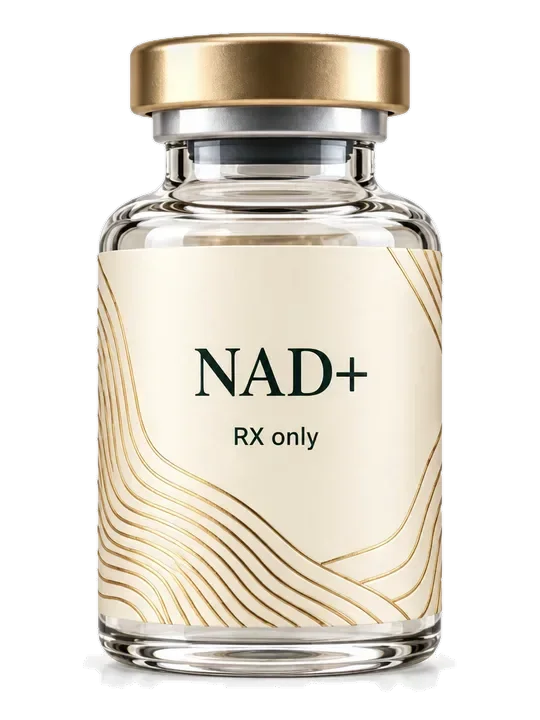
A compounded NAD+ protocol prepared per order, shipped with all supplies and a clear usage schedule.
NAD+ and cellular energy
NAD+ protocols and cellular support built around daily energy, focus and healthy aging over the long run.
Your options
Compare formulations and review each treatment’s science, safety information and available options.
Loading treatments…
Understanding the approach
NAD+ is a coenzyme found in every cell of your body, central to how your cells convert food into energy. Levels naturally decline with age — which is one reason energy, focus and recovery can feel harder to hold onto over time.
Our longevity protocols are designed to support NAD+ levels with a simple, repeatable routine. Each formulation is compounded fresh at 503A pharmacies and shipped on a schedule you control.
Think of it as maintenance for the systems that do everything else: steadier daily energy, sharper focus, and support for healthy aging at the cellular level.
The evidence
Research describes the studied ingredient, population and delivery method—not a guarantee of results from this compounded formulation. Evidence may be preliminary or based on laboratory, animal or precursor studies. Your clinician determines whether treatment is appropriate. Compounded medications are not FDA-approved.
Growth hormone is released by the pituitary gland in pulses, the largest of which happens during deep sleep. Sermorelin binds to the same receptor as the body's own GHRH and prompts the pituitary to release growth hormone in that same pulsed pattern.
Because the pituitary stays in control, the body's normal feedback loop remains intact. When growth hormone and IGF-1 rise, the pituitary slows its own release, which is one reason sermorelin is studied as a more physiologic approach than injecting growth hormone directly.
The tablet is a needle-free option, compounded in 2 mg and 5 mg strengths so your provider can set the dose to your goals. It is taken daily at bedtime.
Clinical studies (Walker, Clinical Interventions in Aging 2006) showed sermorelin increases growth hormone and IGF-1 in older adults while preserving natural feedback controls.
Inside every cell, NAD+ helps the mitochondria convert food into ATP, the fuel your cells run on. It also powers the repair enzymes that fix everyday DNA damage, including PARPs and sirtuins, which help regulate metabolism and inflammation.¹
In one study of human tissue, NAD+ levels dropped steadily from youth to older age, alongside rising DNA damage.² Research links that decline to fatigue, slower metabolism, and age-related decline, and restoring NAD+ is studied as a way to support healthy aging.¹
Injectable NAD+ delivers the molecule itself, rather than relying on precursors that must first be processed by the gut and liver.
Reviews in Cell Metabolism and Science describe the age-related decline of NAD+ and its role in mitochondrial function and DNA repair.
Early human trials of NAD+ precursors show increased NAD+ levels and good tolerability; long-term outcome data are still emerging.
Inside every cell, NAD+ helps the mitochondria convert food into ATP, the fuel your cells run on. It also powers the repair enzymes that fix everyday DNA damage, including PARPs and sirtuins, which help regulate metabolism and inflammation.¹
In one study of human tissue, NAD+ levels dropped steadily from youth to older age, alongside rising DNA damage.² Research links that decline to fatigue, slower metabolism, and age-related decline, and restoring NAD+ is studied as a way to support healthy aging.¹
The nasal spray is absorbed through the nasal lining, bypassing the digestive tract.
Reviews in Cell Metabolism and Science describe the age-related decline of NAD+ and its role in mitochondrial function and DNA repair.
Early human trials of NAD+ precursors show increased NAD+ levels and good tolerability; long-term outcome data are still emerging.
Inside every cell, NAD+ helps the mitochondria convert food into ATP, the fuel your cells run on. It also powers the repair enzymes that fix everyday DNA damage, including PARPs and sirtuins, which help regulate metabolism and inflammation.¹
In one study of human tissue, NAD+ levels dropped steadily from youth to older age, alongside rising DNA damage.² Research links that decline to fatigue, slower metabolism, and age-related decline, and restoring NAD+ is studied as a way to support healthy aging.¹
Oral NAD+ is a simple daily option that can be used on its own to help keep levels steady.
Reviews in Cell Metabolism and Science describe the age-related decline of NAD+ and its role in mitochondrial function and DNA repair.
Early human trials of NAD+ precursors show increased NAD+ levels and good tolerability; long-term outcome data are still emerging.
Glutathione is the most abundant antioxidant molecule your cells make. It protects cells from oxidative damage, helps the liver neutralize and clear toxins, and keeps each cell's internal balance steady.¹
Your body's ability to make glutathione drops with age. In one study, older adults had about half the glutathione of younger adults, along with higher oxidative stress.²
Glutathione levels also matter for immune function. In a six-month trial, daily glutathione raised the body's stores by 30 to 35 percent and more than doubled the activity of natural killer cells, part of the immune system's first line of defense.³ A separate 12-week trial found fewer wrinkles in some areas measured, with trends toward more even tone and better elasticity.⁴
A randomized trial (Richie et al., European Journal of Nutrition 2015) found six months of oral glutathione increased body glutathione stores.
Glutathione's role as a primary cellular antioxidant is well documented in biochemistry literature.
Glutathione is the most abundant antioxidant molecule your cells make. It protects cells from oxidative damage, helps the liver neutralize and clear toxins, and keeps each cell's internal balance steady.¹ Your body's ability to make it drops with age; in one study, older adults had about half the glutathione of younger adults.²
Oral glutathione has been tested directly. In a six-month trial, a daily oral dose raised the body's glutathione stores by 30 to 35 percent and more than doubled natural killer cell activity, part of the immune system's first line of defense.³ In a 12-week trial, daily oral glutathione was linked to fewer wrinkles in some areas measured, with trends toward more even tone and better elasticity.⁴
A randomized trial (Richie et al., European Journal of Nutrition 2015) found six months of oral glutathione increased body glutathione stores.
Glutathione's role as a primary cellular antioxidant is well documented in biochemistry literature.
Thymosin alpha-1 is a 28-amino-acid peptide first isolated from the thymus. It is one of the most studied immune peptides and has been used clinically for decades in a number of countries.¹
Research shows it supports the maturation and activity of T-cells, natural killer cells, and dendritic cells, and helps regulate the inflammatory signals that keep an immune response in check.¹ ²
Studies have also found it can improve vaccine response in older adults, which is why it is studied as a way to counter the immune decline that comes with age.²
Thymosin alpha-1 (thymalfasin) is approved in more than 30 countries for hepatitis B and as an immune adjuvant, and has been studied in thousands of patients.
A study in Radiology (Rodriguez et al., 2016) found low-dose methylene blue increased brain activity linked to memory and attention.
Reviews (Toljan & Vrooman, Medical Sciences 2018) summarize clinical studies of LDN in fibromyalgia, Crohn's disease and other inflammatory conditions.
GHK-Cu is a naturally occurring peptide found in human plasma, saliva, and urine, and your levels decline with age.¹
Research shows it signals fibroblasts to produce collagen,² raises elastin and glycosaminoglycan production, and supports the repair of skin and connective tissue throughout the body.³ It also influences the activity of more than 4,000 human genes, many of them tied to repair and inflammation.¹
That is why GHK-Cu is studied for skin and tissue repair, and why a daily oral dose is a simple way to keep it in your routine.
Pickart & Margolina (International Journal of Molecular Sciences, 2018) reviewed evidence that GHK-Cu stimulates collagen synthesis and wound healing.
Topical niacinamide has been shown in clinical studies to improve skin barrier function and evenness of tone.
Personalized care
Common questions
Your next step